Menstrual health is often not talked about openly. Because periods can be a private topic, many women don’t realize that symptoms they’ve been living with for years may not actually be normal.
One of the most common examples is heavy menstrual bleeding.
Many women assume their periods are “normal” simply because they’ve always been that way. If you’ve had heavy periods since your teens, you may have nothing else to compare them to. Others may hear friends, family members, or coworkers describe similar symptoms and conclude that heavy bleeding is just part of being a woman.
But there’s an important distinction to make:
Just because something is common does not mean it’s normal.
Heavy menstrual bleeding affects many women, but it can be a sign of an underlying issue that deserves attention.
What Is Considered Normal Menstrual Bleeding?
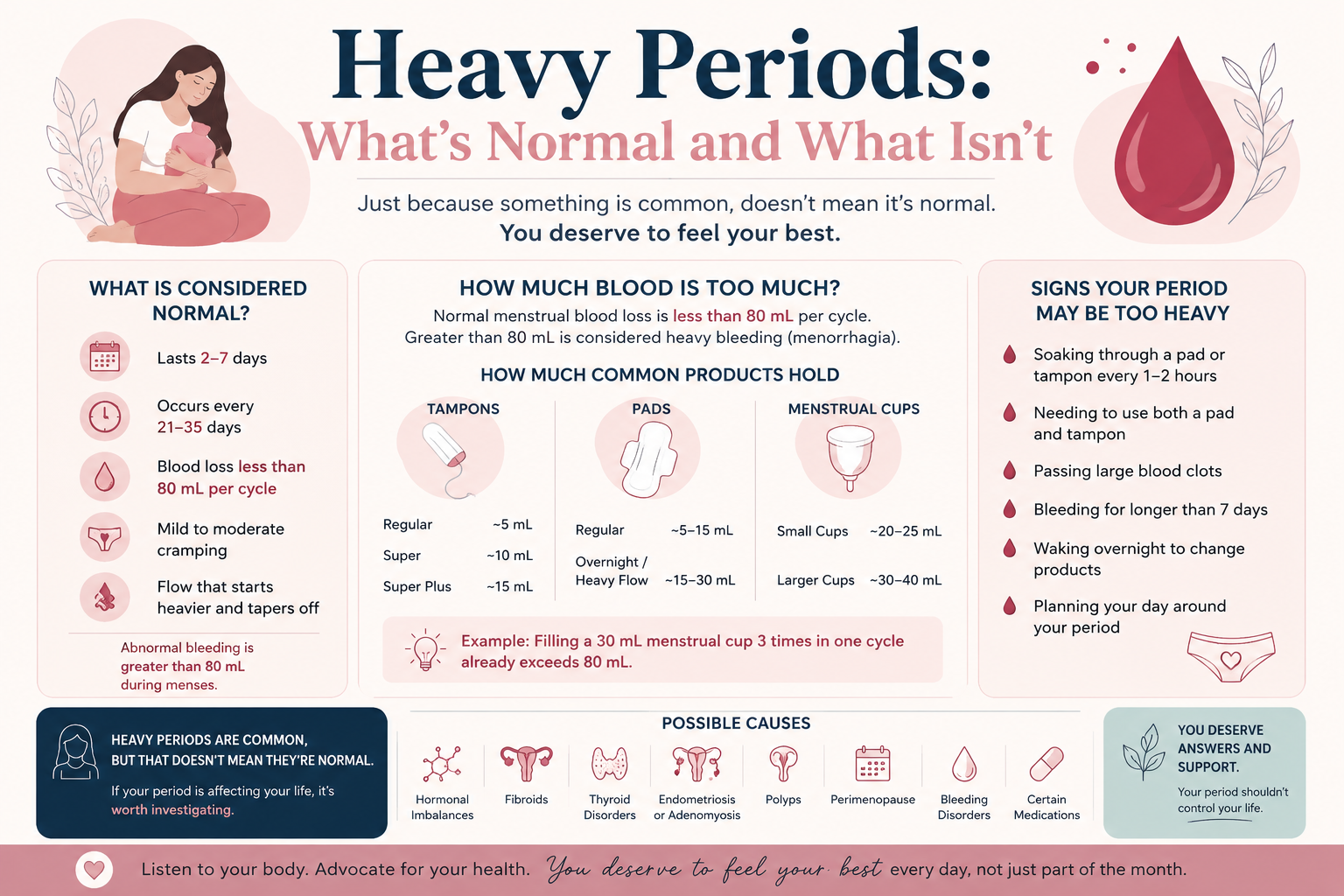
A typical menstrual period lasts between 2 and 7 days and occurs every 21 to 35 days.
From a medical perspective, normal menstrual blood loss is considered to be less than 80 mL during an entire period. Blood loss greater than 80 mL is classified as menorrhagia, or heavy menstrual bleeding.
The challenge is that most women aren’t measuring their menstrual blood loss, making it difficult to know whether they’re above this threshold.
How Much Blood Do Period Products Hold?
While every product varies slightly by brand, the following estimates can help provide some perspective:
Tampons
- Regular: approximately 5 mL
- Super: approximately 10 mL
- Super Plus: approximately 15 mL
Pads
- Regular pad: approximately 5–15 mL
- Overnight or heavy-flow pad: approximately 15–30 mL
Menstrual Cups
- Small cups: approximately 20–25 mL
- Larger cups: approximately 30–40 mL
For example, if you are completely filling a 30 mL menstrual cup three times per cycle, you’ve already exceeded the 80 mL threshold considered normal.
Signs Your Period May Be Too Heavy
Heavy menstrual bleeding isn’t just about the total amount of blood loss. Other signs include:
- Soaking through a pad or tampon every 1–2 hours
- Needing to use both a pad and tampon together
- Frequently leaking onto clothing or bedding
- Passing large blood clots (larger than a quarter or loonie)
- Bleeding for longer than 7 days
- Waking overnight to change menstrual products
- Planning your daily activities around your period
Heavy bleeding can also contribute to iron deficiency and anemia, which may lead to:
- Fatigue
- Brain fog
- Shortness of breath
- Dizziness
- Headaches
- Reduced exercise tolerance
Why Heavy Periods Shouldn’t Be Ignored
Heavy menstrual bleeding can occur for many reasons, including:
- Hormonal imbalances
- Fibroids
- Polyps
- Adenomyosis
- Endometriosis
- Thyroid disorders
- Perimenopause
- Bleeding disorders
- Certain medications
While heavy periods are common, they should not simply be dismissed as “just the way your body works.”
The Bottom Line
If you’ve always had heavy periods, it can be difficult to recognize that what you’ve come to accept as normal may actually warrant further investigation.
Menstrual health isn’t always discussed openly, and many women spend years believing their symptoms are simply something they have to live with. But understanding what constitutes normal menstrual bleeding is an important first step toward identifying potential concerns.
If your periods are affecting your energy, quality of life, work, exercise, or daily activities, it’s worth having a conversation with a healthcare provider. Heavy periods are common—but common doesn’t always mean normal.